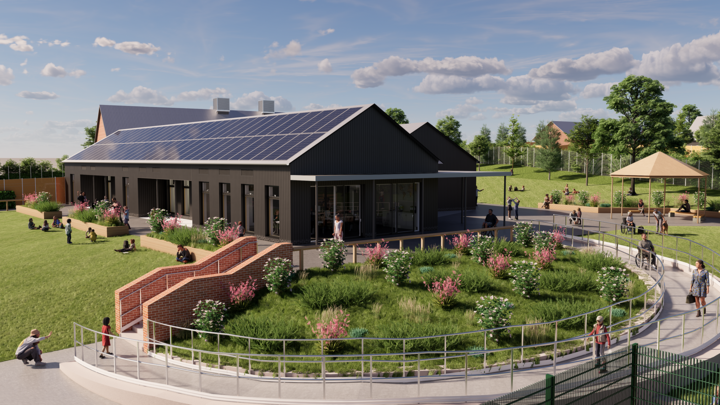
They are not simply educational buildings but environments that build confidence, independence and joy. When done well, the architecture supports development without ever drawing attention to itself. It quietly supports every step of a pupil’s journey forward.
Richard PaigeDirector, NVB
Much of mainstream educational architecture is governed by standardisation and design principles dictated from the centre. While these frameworks offer consistency, they often fall short of serving those pupils whose needs diverge from the standard model. In the world of Special Educational Needs (SEN), design must do more. It must listen harder, think deeper, and respond more sensitively.
At NVB, we have found SEN design to be one of the most rewarding and demanding areas of our work. These projects aren’t about ticking boxes, they are about understanding individuals and each school is as unique as the cohort of pupils, therefore design must reflect that reality.
True SEN design begins with in-depth conversations with the headteachers, therapists, carers, and classroom staff who live the day-to-day experience. Their knowledge is vital. While we may have internalised technical standards and best practices, the most valuable tool we bring to the table is empathy. These are schools that support pupils with needs ranging from Moderate Learning Difficulties to Profound and Multiple Learning Disabilities. And within that range is an even greater spectrum of nuance and complexity. Being open to questioning standard solutions within the constraints of budget and safety allows for environments that are not only functional, but uplifting.

Materiality as therapy
In SEN environments, materials do far more than finish a space, they shape experience. Natural materials bring warmth and calm and contrasting textures help wayfinding. A carefully curated sensory landscape can help manage overstimulation or provide needed stimulation. Biophilic design principles are especially powerful and bring nature indoors creating a soothing backdrop for learning. A consistent, calm palette supports emotional regulation and ease of navigation. Just as importantly, the materials must also be durable, easy to clean, and safe to use for pupils who may have complex physical or behavioural needs. Far too many schools built for vulnerable learners end up looking like secure units. Of course, we must prioritise safety but we reject the idea that safety requires sterility. Through intelligent landscaping, considered massing, and careful zoning, we can create buildings that are protective but not punitive, secure but not segregated.
Designing with difference in mind
Every SEN school shares some common ground: spaces to eat, play, and learn. But beyond that, their requirements diverge dramatically. A school catering to pupils with Profound and Multiple Learning Difficulties (PMLD) will require hoisting systems, sensory rooms, and specialist therapeutic equipment. A Pupil Referral Unit (PRU) will prioritise safety, emotional wellbeing, and behaviour regulation. There is no single solution, only design that is deeply contextual and responsive. And that’s where architectural creativity thrives.
Some of the most exciting moments in our SEN work come when schools and local authorities are willing to be ambitious. For example, Mountjoy School in Dorset, situated in a rural location but severely restricted by its existing footprint.
The school dreamt of expanding its provision in a way that gave learners space, purpose, and connection to the landscape. Working together, we developed a “farm school” concept on adjacent land, complete with animal paddocks, poly tunnels, horticultural areas, and a community café, all framed in agricultural-style barns that blend with the landscape. Beyond education, this project offers life skills and even employment opportunities for older pupils.
At Beacroft College, also in Dorset, we took a successful in-school café experiment run by pupils for the local community and designed a purpose-built café that blurs the boundary between school and society. It will look and feel like any other café in town, yet it exists as a learning space where pupils can grow in confidence and capability, connecting their education to real-world experience.
Finally, Woodlands School is a PRU (Pupil Referral Unit) we are converting from a disused primary into a welcoming haven for pupils with often challenging relationships with education. Rather than paving over the grounds with tarmac, we embraced the woodland that gives the school its name. The outdoor learning happens under the trees, and landscapes are sculpted not just for supervision and safety but for stimulation, self-discovery, and calm.

Avoiding Institutional Feel - A well designed SEN school should feel like any great school
One of the greatest risks in SEN school design, especially in PRU’s, is the inadvertent creation of institutional or prison-like environments. Fencing, while often necessary, must be deployed carefully. Where possible, we embed secure lines within buildings or soften boundaries through landscaping and planting. Just as important is spatial planning that avoids segregating pupils by visible barriers. A better strategy is zoning by function and mood, giving anxious pupils access to calm outdoor space without crossing high-activity zones used by more physically expressive pupils.
Ultimately, our job is to help every pupil access every learning opportunity available to them. This could mean designing a dining hall that becomes a café. Or creating outdoor classrooms among trees or building flexible spaces that allow for both calm focus and energetic play.
They are not simply educational buildings but environments that build confidence, independence, and joy. When done well, the architecture supports development without ever drawing attention to itself. It quietly supports every step of a pupil’s journey forward.
This article was first published in Building Design on 12 February 2026
You can read the full original article here https://www.bdonline.co.uk/opinion/designing-for-difference-how-thoughtful-architecture-can-transform-sen-environments/5140261.article